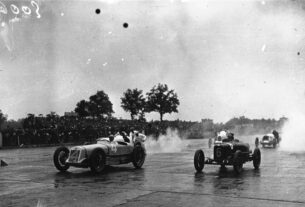
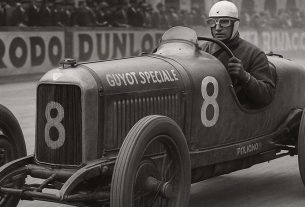
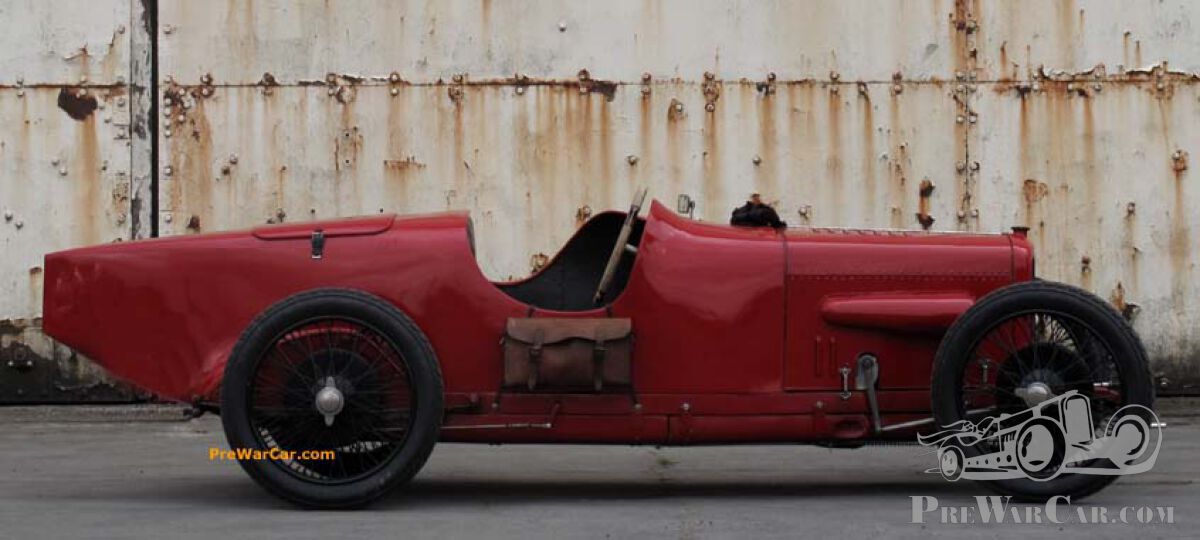
The roaring twenties an era of economic prosperity the years when the sky was the limit. People started dancing on Jazz music, the fashion become more exciting and modern. People started enjoying life in a modern way, as we have today. The era that evolved motorsport to a new standard, professional and serious. Car manufacturers started in both the States, Australia and Europe investing serious money in motorsport. Via this platform, they were able to show the world what their cars could do. Grand Prix driving would never be the same again after World War I. The sport had more flair, more passion and became an elite sport. Time to see which unraced cars 1923 brought us.
As the 1923 Grand Prix season happened 103 years ago, the information regarding unraced Grand Prix Cars, stillborn projects and so on is hard to find. The information in old Magazines and newspapers is just a little to complete the big picture. Neither are there really books from that era. Same goes for the race reports. The search now is mostly on entry reports and the books I own from Grand Prix and Voiturette Racing. Therefore, it could be I miss some projects, if this is the case let me know.
Alfa-Romeo P1
Giuseppe Merosi designed for 1923 the Alfa Romeo Tipo P1. It was their first Grand Prix car and was completed in May 1923, the P1 would made his debut during the Italian Grand Prix. Antonio Ascari, Ugo Sivocci and Guiseppe Campari would race with the cars. The car was tested prior the Grand Prix by Ugo Sivocci the results were positive. On the Friday during the free practice everything went wrong. Ugo crashed badly with the P1, and died because of the crash. Soon after Alfa Romeo came with a press release that they withdrew from the Grand Prix and the rest of the season. As of Ugo’s dead, number 17 has never again assigned to Italian Racing cars.
Constantino Petromilli (CIP)
Cyclecar Italiana Petromilli was an Italian car manufacturer established by Constantino Petromilli in 1921 and situated in Turin. Constantino was also the designer of the cars that CIP produced. The company produced mostly Cyclecars and was well known for it’s 1075 model. While the company was growing it seems the step was taken for a Grand Prix car. During the I Gran Premio Cyclecars di Milano held the 29th of April 1923 at Monza three cars were on the entry list.
Constantino Petromilli with car number 14, Morano with car number 15 and the third car with number 16 without a driver. The cars did not appear at the start, no further reason was given. During the Formula Libre III Circuito del Garda race held the 25th of November a Petromilli appeared again, and for the last time, on the entry list. It seems that Constantino Petromilli gave it another try. However, also this time the car did not appear.
Constantino’s company would continue building cars until late 1924 when he was forced to close the doors of its factory.
Della Ferrera
There is not much known about the Della Ferrera cyclecar that appeared on the start list for the I Grand Premio Cyclecars di Milano the 29th of April 1923. It is known that the company worked on their cyclecar for 1924. Giulio Aymini with car number 17 would race with the Della Ferrera.
Marseal Coventry Simplex
Marseal started in 1918 as Marseel the company was specialised in manufacturing gearboxes for the Emscote cars. The company had a surplus on their gearboxes and therefore used them with Coventry Simplex engines to make complete cars out of it. In 1923 the company changed it name to Marseal as one of their owners quit. Interestingly is the fact that if you look up the company their first sportscars they produced were from 1926 onwards.
In 1923 Donald Marendaz appeared on the entry-list for the II Junior Car Club “200” race at Brooklands the 13th of October 1923. He had number 23 and in first instant quailed himself for the Voiturette race. However, he was refused entry for the race as his car failed a silencer test. It is not sure which type of car they appeared with on the track.
Warwick Janvier
The Warwick Janvier car is another unknown car that appeared on the entry list for the
III Junior Car Club “200” at Brooklands the 13th of October 1923. All that is known that the company entered two cars. One for Sammy Newsome(4) and Keith Peacock(19). The cars did not appear at the start of the Grand Prix. If you have more information about this car let me know!
Eric Campbell Coventry Simplex
Eric Campbell was a British car manufacturer established in 1919 by Hugh Eric Orr-Ewing and Noel Campbell Macklin. The company was known for producing light cars fitted with a 1505cc Coventry Simplex engine. Already in 1919 two cars were entered for the Targa Florio. This was also the begin of the end for the company. The company struggled in 1920 financially and Macklin left the company in 1920. The production of cars would soon happen with a company named Vulcan Iron Works.
Despite the financial difficulties, which would bring the company to bankruptcy in 1926, the company appeared on the entry list for the III Junior Car Club “200” at Brookland the 13th of October 1923. Henry Smith(22) was their driver. The car did not appear on the track. It is not known which car was to race.
Newton
The Newton was specially designed for the 200 mile race at Brooklands the 13th of October 1923 by Noel Newton. Two cars appeared on the entry list with Noel Newton(3) and Olivo Pellegatti(4). The cars were unable to race because of the banking at Brooklands. It was severe enough to allow the oil to surge to one side in the sump.
Imperia
In 1923 there were two car manufacturers with the name Imperia. One was established in Germany and the other in Belgium. An Imperia, probably Belgium manufacturer, appeared on the entry list for the II Junior Car Club Cyclecar “200” at Brookland the 13th of October 1923. Interestingly is the name of Kaye Done(14) as their driver. Who does not know his name, he is well known for the speed records he broke on land and water. At that time he was a well-known motorcycle racer. He would only make the move to car racing in 1926. Perhaps this was his first attempt. The car appeared not at the start because the car was not scrutineered.
AGA 6/30PS
AGA was a German car manufacturer established in 1914 and produced their first car in 1919 the Type A. The company appeared at the start of many races at that time. In 1923 the company appeared with the AGA 6/30PS at the start of several Hillclimb races. The car appeared also on the entry list for the III Gran Premio do Penya Rhin at Villafranca the 21nd of October 1923.
Eric Stahl(3), Jakob Scholl(12) and a driver named Philip(16) would drive the AGA 6/30PS for the company. For unknown reasons the team did not appear at the start of the race. Later that year the AGA would appear at other Hillclimb races.
Another AGA, probably the 6/30PS appeared on the entry list for the III Circuito del Garda at Salo the 25th of November 1923. Luigi Pagani(16) was the driver. For unknown reasons they did not appear at the race.
Garriga
The Garigga appears in several records as the Carriga, which is not a car brand. Garigga was a Spanish established in 1923 in Barcelona. Nothing much is known, as the company would close it’s doors the same year. Yet, they appeared at the start of the III Gran Premio do Penya at Villafrance the 21s of October 1923. R. Rambia(5) was assigned as their driver. They did not appear at the start of the race.
E.H.P.-Ruby
E.H.P.( Établissements Henry Precloux) was a French car manufacturer established in 1921. They stopped manufacturing cars in 1929, while others made in license as well the E.H.P. cars. Most of the cars were fitted with the small and reliable Ruby engines. The manufacturer would appear in the mid-1920s at the start of the 24 Hours of LeMans. They would appear at the start from 1925 until 1928.
In 1923, an E.H.P. appeared at the start of the I Gran Premio d’España Cyclecars in Sitges the 1st of November that year. Boris Ivanowsky was the driver. The car did not appear at the start of the race.
Citroën B2
It seems that two Citroën B2’s appeared on the entry list for the I Gran Premio do San Sebastian Voiturette at San Sebastian the 30th of July 1923. Lionel de Marmier and Grosset appeared on the entry list as the drivers.
Windsor
Windsor was a British car manufacturer established in 1923 and folded in 1929. Not much is known. A Windsor appeared on the entry list for the II Junior Car Club Cyclecar “200” at Brooklands appeared on the entry list. K. Cater was their driver. Eventually they did not appear at the track.