If I say Ginetta I’m sure that many Brits know the brand. It is one of the typical British manufacturers of sports cars and single-seaters through the years. I came across Ginetta years ago when I was doing research on something else. It seemed that they worked on their own Formula One car in 1969/1970 and in the mid-70s worked on their own 1,5-litre turbo charged F1 engine. During the Covid-pandemic I came in contact with Trevor Pyman who wrote a book about the manufacturer “Ginetta Road and track cars”. I couldn’t leave the book and purchased a copy from him, one of the best books automotive related I ever purchased. Thanks to this book, and finally ready to, here is the story about Ginetta’s Formula One plans and their other single-seaters.
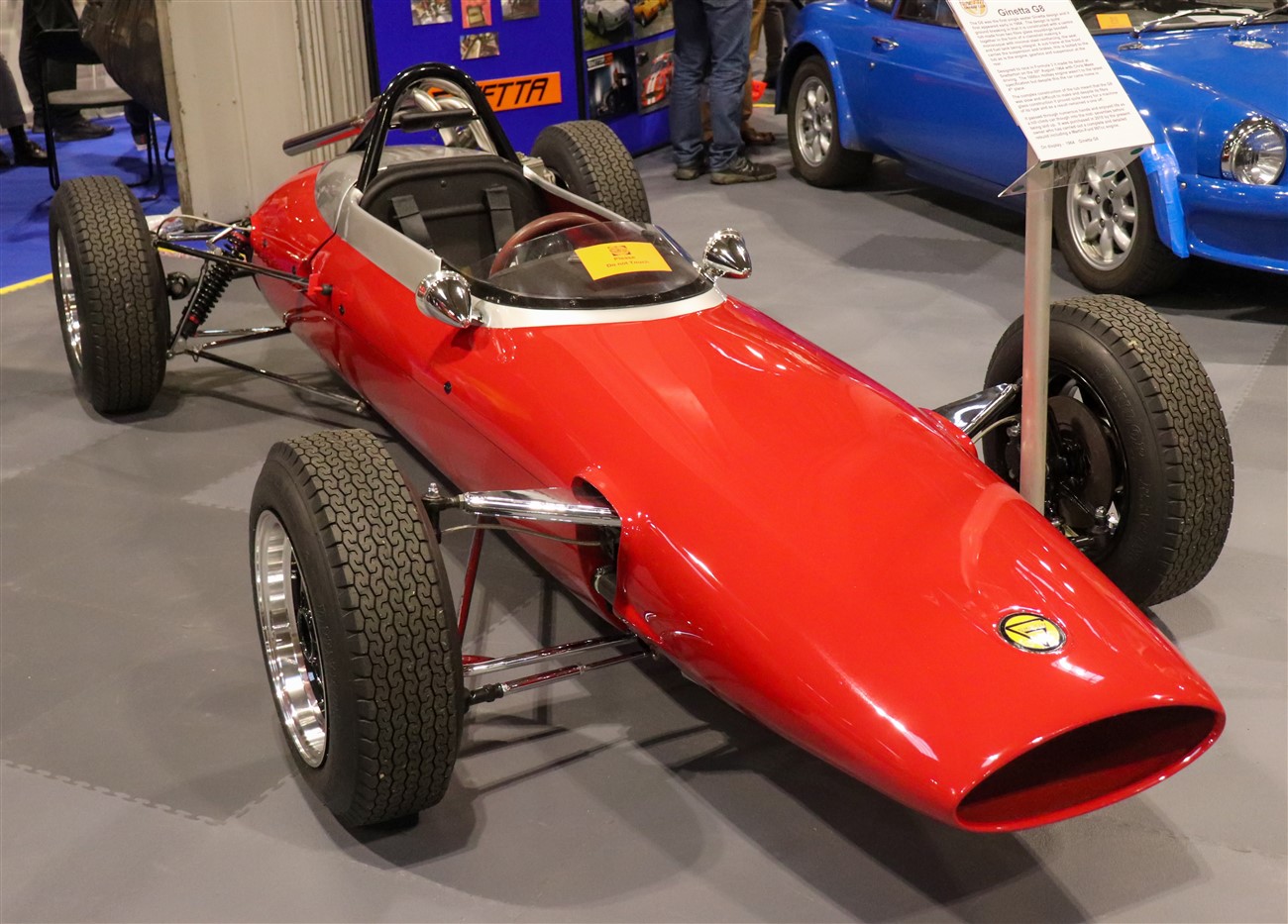
The Walklett Brothers established Ginetta in February 1958. After Ivor Walklett (one of the brothers) had built his first car in 1957 the Ginetta G1. Which, sadly, does not have surviving photos. A sketch of the G1 made by Ivor himself shows a car that lets itself describe as a special-build a type of car that was popular in the 1950s and the 1960s. Soon after Ginetta was established, in late 1957 Ivor, inspired by the Lotus 6, worked on the first car build by their company the G2. History got written, and the company kept on growing and kept on producing new cars. In June 1964, the company announced their first single-seater the G8 “If Lotus could build single-seater cars successfully so could Ginetta” as quoted from Trevor Pyman’s book Ginetta Road and Track cars.
This Formula 3 car was designed in late 1963, with a tube made out of fibreglass. Trevers Walklett tested it for the first time in 1964 at Snetterton while at the same time Graham Hill was testing there for BRM. Interestingly is that they gave the Ginetta team some tips how to solve the issue with the judder steering. The car would made it’s debut the 30th of August 1964 with Chris Meek behind the wheel of the G8. He would finish the race as fourth; after chasing Frank Williams ahead of him! While showing a great result the brothers decided to abandon the project, as they did not have the money to upgrade their engine. Shortly after, the design on the G9 was started; this was to be a Formula 2 car. Yet, also this project got abandoned.
Willie Green had placed an order for the G9, while he visited the factory he decided there to choose another car for his adventure. Therefore, the G9 got sidelined as well and never saw a complete status. The focus went to sports cars where the Ginetta G12 and later the G16 became a popular car to race. This did not mean that the single-seaters were a passed station. The Ginetta G17 (Formula 4) and G18 (Formula Ford) were more or less study models for single-seaters. The focus lay on the new Formula 4 and Formula Ford. Chris Meek debuted in the Formula Ford in Rufforth with the G18, while the start was good he eventually had an engine that had it’s own life.
There was another single-seater on it’s way the Ginetta G19, their own Formula One chassis. It was Ivor’s last single-seater idea; it would have brought Ginetta in the highest levels of autosport. In 1969, the G19 was designed as a new Formula 1 car. This project was for the brothers as serious one. The car was a beefed version of the G18, a space-frame chassis and fully adjustable wishbone suspension. As the company started working with BRM, the plan was to further associate with BRM. They wanted to install BRM’s 3-litre V12 engine and BRM in-house made gearbox in the back of the G19. Perhaps BRM’s situation in the Formula One in 1969 was the beginning of the end for the G19. The team struggled badly with the P142 and earlier the P133 and P138. Was it a reality check for the Brothers? Perhaps it was. While BRM saw better results in 1970, the Ginetta G19 would never see the day of light. While the company was able to construct their car, the problem was funding the team. At that time, the Formula One became bigger and the costs to run a team raise as well. It was not the mid-1960s anymore.
However, this was not their last flirt with the Formula One, in the mid-1970s they came with the idea of a 1,5-litre two –stroke Formula One engine. This was somewhat a revolutionary idea with twelve tiny cylicnders horizontally opposed and turbo-charged. It could have been the first turbo-charged engine in the Formula One. Casting was made for the engine, though due to other projects the engine was put aside.